TriggerNet
An Explainable AI Framework for Red Palm Mite Detection
| Year | 2025 |
|---|---|
| Location | Anna University |
| Tags | Explainable AI, CNN, EfficientNet, YOLOv8 |
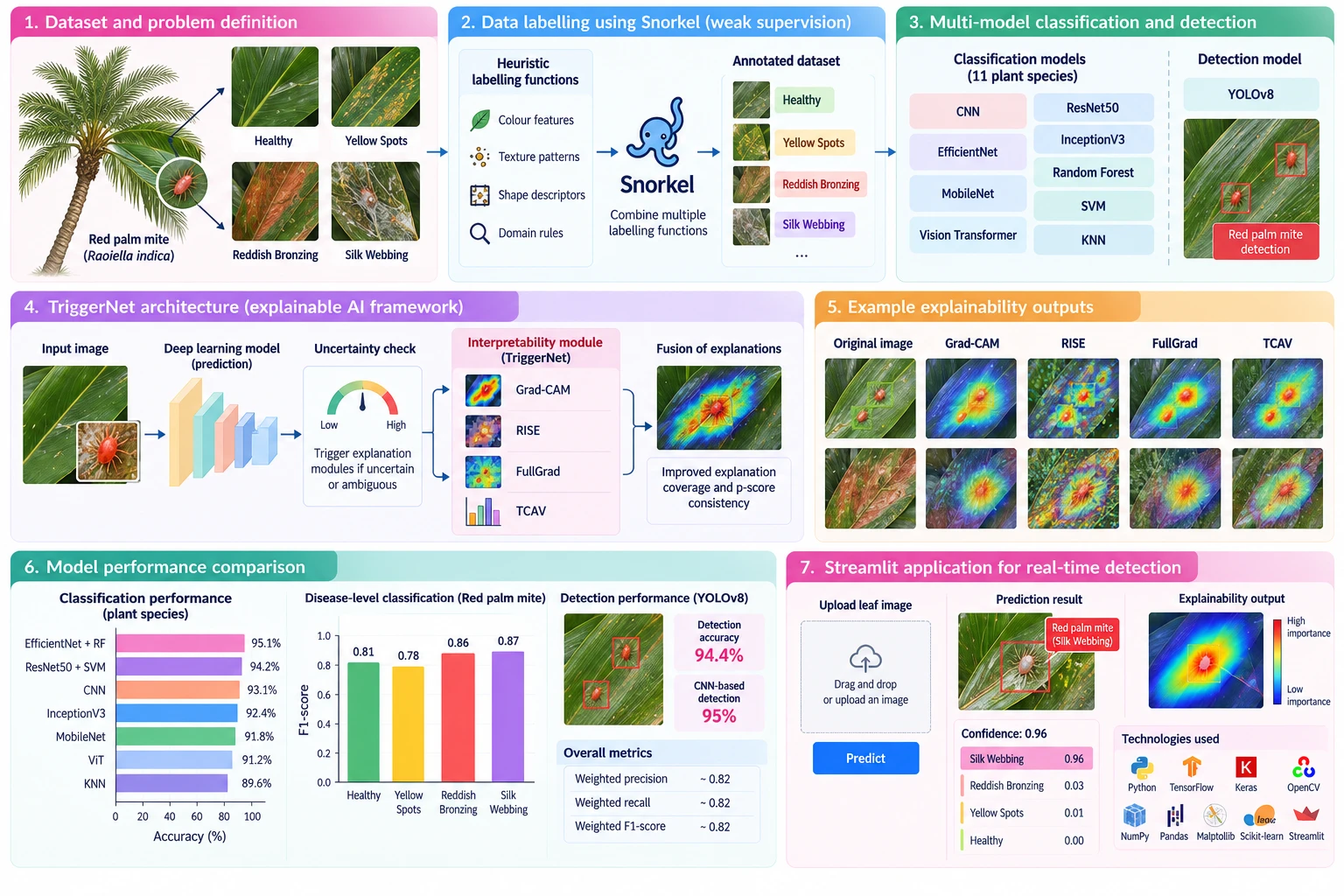
Grad-CAM, RISE, FullGrad and TCAV fused into a hierarchical interpretability pipeline across 11 plant species; 95.1% accuracy with EfficientNet + Random Forest and 94.4% detection with YOLOv8, served in a Streamlit app.
Nov 2024 – Feb 2025 at Anna University, Chennai, supervised by Sunil KC. Presented at 13th ICCET Conference.
- 01Dataset & weak labels
RGB images across 11 plant species, labelled into four classes (Healthy, Yellow Spots, Reddish Bronzing, Silk Webbing) using heuristic weak supervision to cut manual annotation.
Snorkel, OpenCV - 02Model comparison
Compared deep and classical models side by side.
CNN, EfficientNet, MobileNet, Vision Transformer, ResNet50, InceptionV3, Random Forest, SVM, KNN - 03Detection
Trained an object detector to localise infestation on leaves (94.4% detection accuracy).
YOLOv8 - 04Explainability pipeline
Fused four attribution methods in a hierarchical pipeline that switches explanation modules on when predictions are uncertain or classes are ambiguous.
Grad-CAM, RISE, FullGrad, TCAV - 05Results
95.1% accuracy with EfficientNet + Random Forest and 94.2% with ResNet50 + SVM; disease F1 of 0.87 for Silk Webbing and 0.86 for Reddish Bronzing.
Scikit-learn, Matplotlib - 06App
An interactive app for real-time infestation detection with explanations.
Python, TensorFlow, Keras, Streamlit