Stimulation-Resolved Multi-Omics Analysis of Cardiovascular & Immune Cohorts
Multi-Omics & Computational Immunology
| Year | 2026 |
|---|---|
| Location | IISc |
| Tags | CellRanger, scVI, MAST, Harmony |
Bulk and single-cell pipelines for CD3, CD28, PMA and P3971 stimulation panels: STARsolo / CellRanger, Harmony and scVI batch correction, DESeq2, limma-voom, MAST and GLMMs, run reproducibly on SLURM with Docker.
Jun 2025 – Jun 2026 at IISc, Bangalore, supervised by Prof. Dipankar Nandi & Dr. Payel Roy.
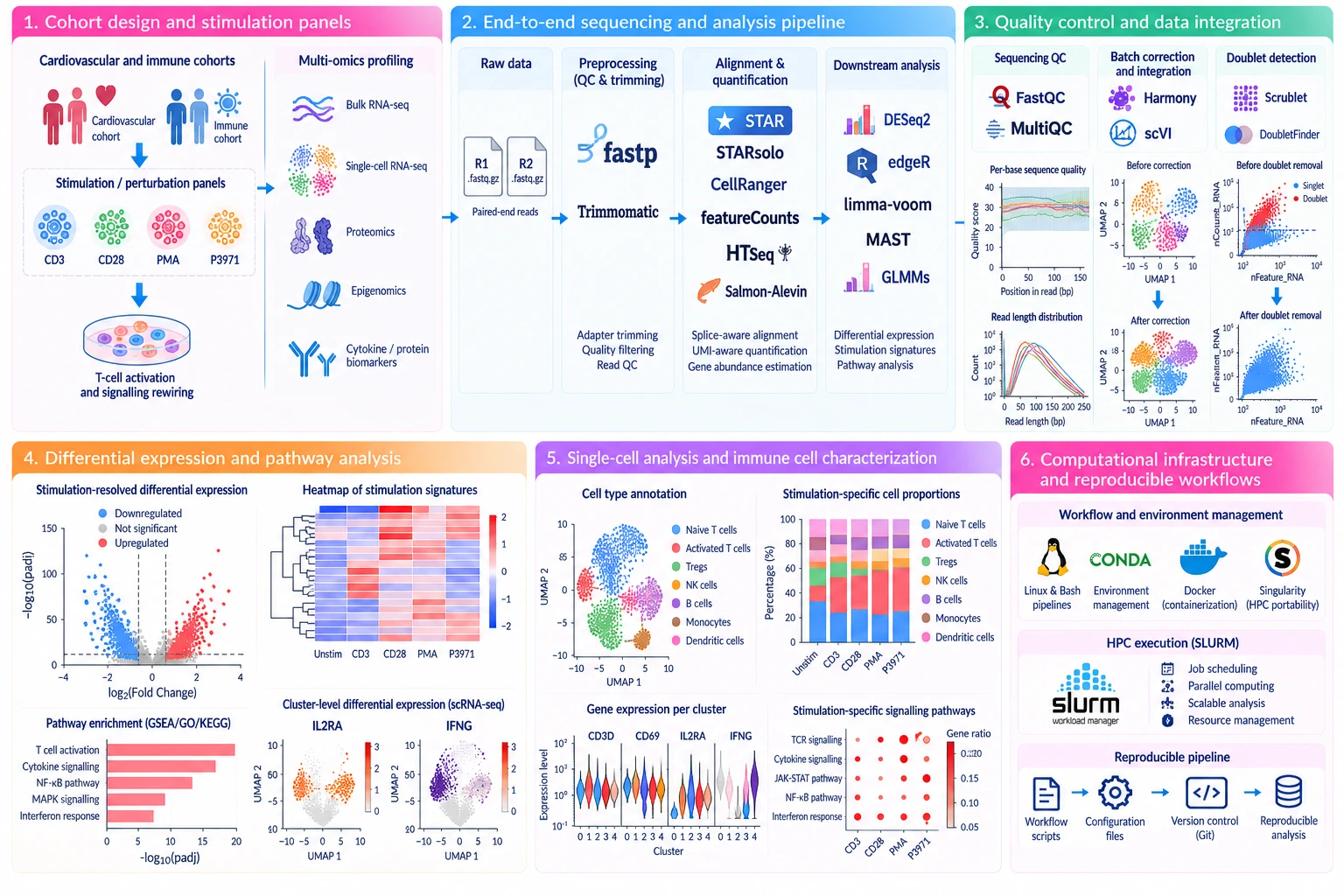
- 01Experimental design
Stimulation-resolved cardiovascular and immune cohorts with CD3, CD28, PMA and P3971 perturbation panels to study T-cell activation and signalling.
Perturbation panels - 02Read processing
Read-level processing, splice-aware alignment and UMI-aware quantification for bulk and single-cell data.
fastp, Trimmomatic, STAR, STARsolo, CellRanger - 03Quantification
Gene abundance estimation.
FeatureCounts, HTSeq, Salmon-Alevin - 04QC & correction
Sequencing and expression QC, batch-aware correction and doublet removal.
FastQC, MultiQC, Harmony, scVI, Scrublet, DoubletFinder - 05Differential analysis
Gene- and cluster-level differential analysis accounting for between-sample variation.
DESeq2, edgeR, limma-voom, MAST, GLMMs - 06Reproducible compute
Portable workflows on a SLURM HPC cluster with managed environments and containers.
Linux & Bash, Conda, SLURM, Docker, Singularity