A Multi-Method Interpretability Framework for Probing Cognitive Processing in Deep Neural Networks
Multi-Method Model Interpretability
| Year | 2025 |
|---|---|
| Location | NeurIPS 2025 workshops |
| Tags | Grad-CAM, TCAV, ViT, MedMNIST |
TriggerNet extended across vision, agricultural and biomedical imaging (MedMNIST, CIFAR-10): 97.3% on plant images, a 21.4% gain in p-score and fidelity measured by Pointing Game, Deletion/Insertion AUC and IoU.
Jan 2025 – Jun 2025 at NeurIPS 2025 workshops.
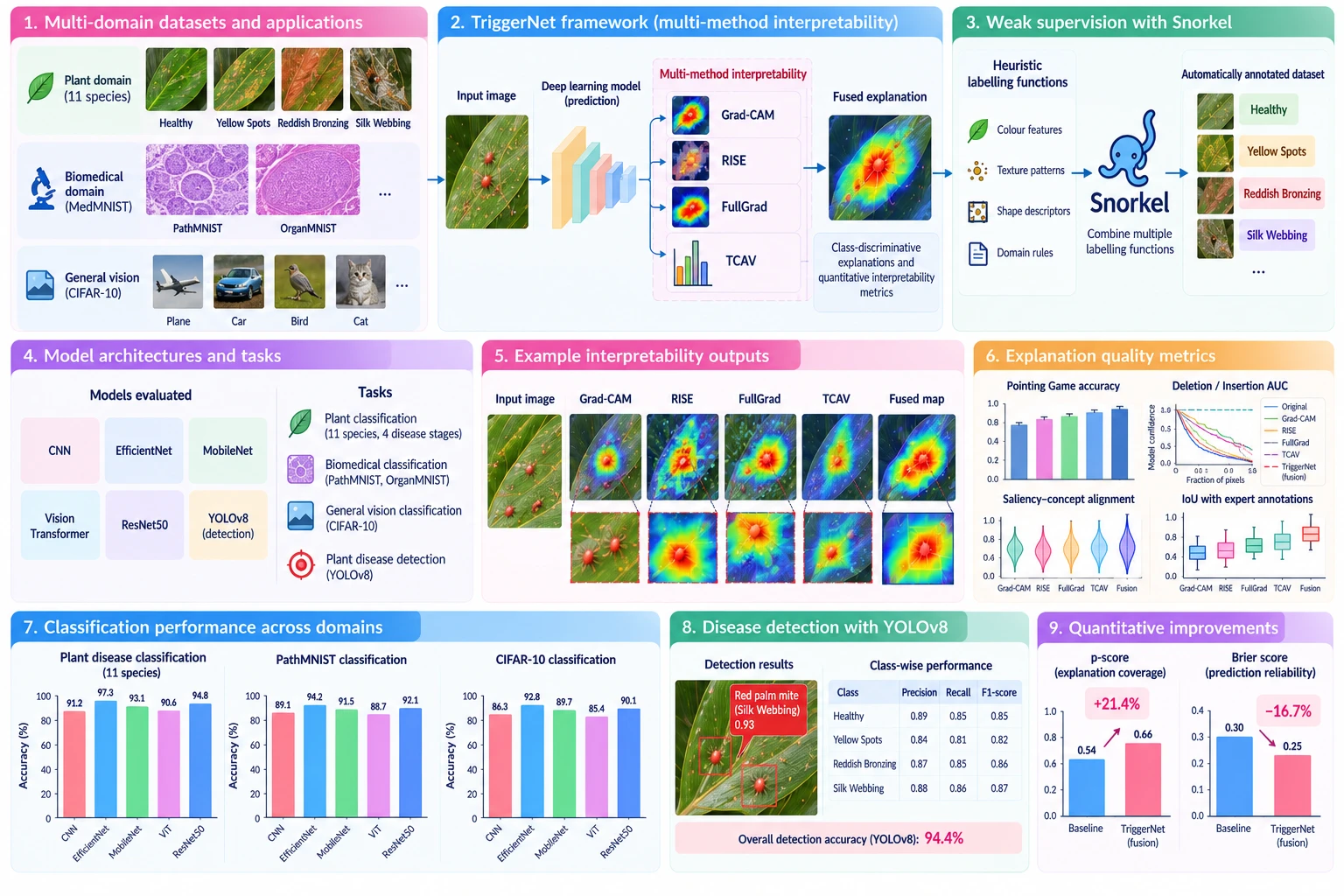
- 01Datasets
Red palm mite plant images (11 species, four disease stages), MedMNIST PathMNIST and OrganMNIST, and CIFAR-10.
MedMNIST, CIFAR-10 - 02Models
Trained and compared several architectures on each domain.
CNN, EfficientNet, MobileNet, Vision Transformer, ResNet50 - 03Multi-method explanations
TriggerNet fuses complementary attribution methods into class-discriminative explanations of what the model is looking at.
Grad-CAM, RISE, FullGrad, TCAV - 04Reliability
Weak supervision for annotation, and explanation quality scored with p-score and Brier score alongside accuracy.
Snorkel, p-score, Brier score - 05Faithfulness
Measured whether explanations point at the right thing against expert annotations.
Pointing Game, Deletion / Insertion AUC, IoU - 06Results
97.3% on plant images, 94.2% on PathMNIST, 92.8% on CIFAR-10, with a 21.4% better p-score and 16.7% lower Brier score than baselines.
Python, PyTorch / TensorFlow